
Flying Internationally With a Dog in the Cabin: What You Need to Know
I’ve been traveling full-time with my Yorkiepoo, Shelby, since 2022, and it feels like flying internationally with a dog keeps getting more complicated.
The U.S. has changed its rules for bringing dogs back into the country, which has made some airlines stop allowing pets on international flights altogether.
Thankfully, things are starting to smooth out as airlines and travelers adjust, but it still takes more planning than it used to.
That doesn’t mean you have to leave your dog behind. You just need the right info and a solid plan to jump through the hoops with less stress.
This guide walks you through exactly what you need to know to fly internationally with your dog in the cabin. I’ll cover:
- What to do months before you book your flight
- How to choose the right airline and carrier
- What tests and paperwork you’ll need for your destination and for coming back to the U.S.
- Tips for getting through the airport and surviving the flight
- Countries that are especially tricky for dog travel
- What to pack, where to stay, and how to avoid common mistakes
I’m not going to talk about cargo travel since I’ve never done it with Shelby. This is all about keeping your dog under the seat in front of you.
Click here to download a checklist to keep track of your dog travel to-do list.
Let’s start at the beginning.

Pre-Travel Preparation
International travel with a dog doesn’t come together overnight. Start planning several months in advance. You’ll need time to:
- Handle paperwork
- Prepare your dog for the flight
- Understand airline and country-specific rules
What to Do in Advance:
- Update ID tags: Include your phone number (with country code) and email. If your dog ever gets separated from you, you want them trackable.
- Book a vet appointment early: You’ll likely need a health certificate issued within 10 days of your departure, plus updated vaccinations.
- Check the rules: Every country and airline has their own. Double-check what’s required both for your destination and your return to the U.S.
- Microchip your dog: Most countries require a 15-digit ISO-compliant chip. Keep your info updated and carry the documentation.
- Ask about calming support: If your dog gets anxious, talk to your vet. Test any meds ahead of time. Airlines won’t allow obviously sedated dogs to board.
Pet Passports in Europe: What You Need to Know
If you’re planning to travel within the European Union (EU) with your dog, a pet passport can simplify the process significantly.
What Is an EU Pet Passport?
An EU pet passport is an official document issued by an authorized veterinarian within an EU member state. It includes:
- Microchip details: Your pet must be microchipped with an ISO-compliant microchip.
- Rabies vaccination record: Proof of a valid rabies vaccination administered after microchipping.
- Other health information: Details of other vaccinations or treatments, such as tapeworm treatment if required.
This passport allows pets to travel between EU countries without undergoing quarantine, provided all requirements are met.
How to Obtain a Pet Passport
If you’re entering the EU from a non-EU country (like the U.S.), you cannot obtain an EU pet passport before arrival.
Instead, you’ll need an EU animal health certificate. It must be issued by an official veterinarian in your country of departure no more than 10 days before entering the EU.
This certificate is valid for travel within the EU for up to four months or until the rabies vaccination expires, whichever comes first.
Once in the EU, you can visit a local authorized veterinarian to obtain a pet passport for future travels within the EU.
Post-Brexit Considerations
Since January 1, 2021, EU pet passports issued in Great Britain are no longer valid for travel to EU countries. UK residents must now obtain an animal health certificate for each trip to the EU.
For more detailed information, refer to the following resources:
Do You Need a Rabies Titer Test for Europe?
If you’re entering the EU from a country not on the EU’s approved list of low-risk rabies countries, then yes, your dog will need a rabies titer test.
This test confirms that your dog’s rabies vaccine produced enough antibodies to be considered protected.
Here’s how it works:
- The blood test must be done at least 30 days after your dog’s rabies vaccination.
- It has to be processed at an EU-approved lab.
- Your dog must wait 3 months after the blood draw before entering the EU.
If you’re coming from a country on the EU’s approved list (like the U.S. or Canada), a titer test isn’t usually required. But you still need proof of rabies vaccination and a valid health certificate or pet passport.
Bottom Line:
Check if your departure country is considered high-risk for rabies by the EU. If it is, start the titer test process early as it can take several months.
You can find the most up-to-date list of approved countries and labs here:
EU: Traveling with Pets
EU-Approved Rabies Labs
Choosing the Right Dog Carrier
Your dog’s carrier matters just as much as your airline. It needs to be secure, comfortable, and most importantly, fit under the seat in front of you.
I use the PetAmi backpack carrier. It’s a backpack that tilts onto its side to fit under most airline seats. It’s soft-sided, well-ventilated, and one of the roomiest options that still meets airline size limits.
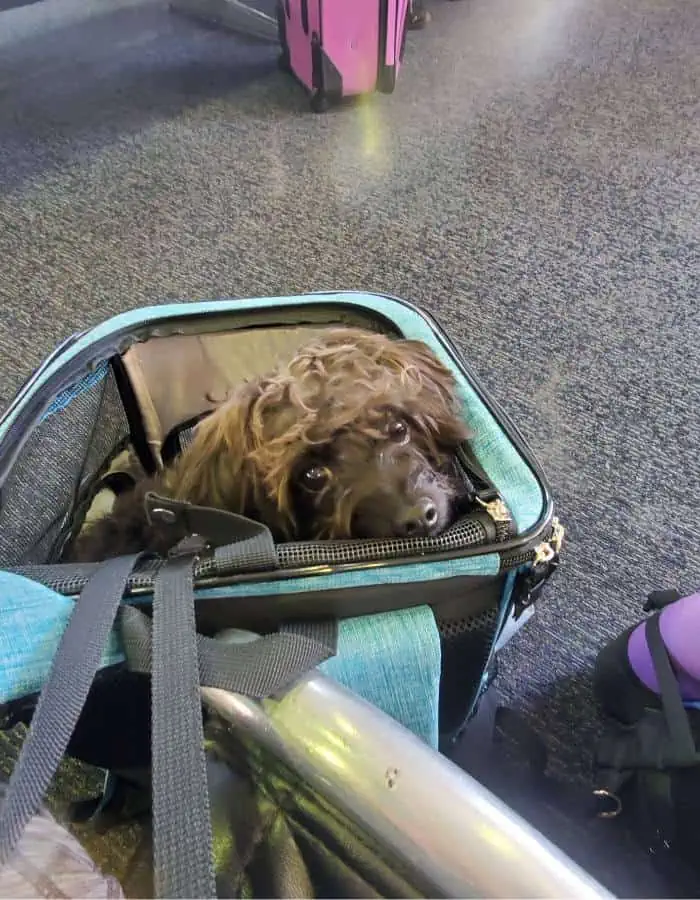
Before You Buy a Carrier:
- Check the size limits for your airline: Every airline has different dimensions, and some budget carriers are especially strict.
- Use a soft-sided carrier: They’re easier to slide under the seat and have a little give, which helps if space is tight.
Tips for Carrier Success:
- Train your dog early by leaving the carrier out at home. Toss in treats, let them nap inside, and take short car rides.
- Don’t overpack it. Some countries (like Mexico) only allow the original carrier pad with no toys or blankets. Shelby almost lost her favorite penguin once because of this.
Booking Your Flight With a Dog
Not all airlines allow in-cabin pets on international routes, so don’t assume. Check before you book.
Every airline has its own pet policy, and they’re not always obvious on the website.
Here’s what to look for:
- Confirm pets are allowed in cabin on international flights: Some airlines only allow it on domestic routes or between certain countries.
- Check the weight limit: Most cap the combined weight of your dog and carrier at 15–20 lbs.
- Reserve your pet’s spot early: Airlines only allow a few pets per flight. You usually need to call in advance to secure your dog’s spot.
- Choose direct flights when possible: Less stress, fewer variables, and no scrambling for relief areas during layovers.
- Budget for extra fees: Pet fees usually run $80 to $200 each way. That’s on top of what you’ll pay for vet visits, health certificates, and potential import permits.
Packing for Your Dog
Here’s what to toss in your carry-on (besides your own stuff):
- 2–3 days of food (in case of delays). Stick with chicken-based options if traveling to countries that ban beef or pork.
- Collapsible water bowl and an empty bottle to fill after security.
- Any medications (in original containers).
- Basic pet first-aid kit.
- Puppy pads, poop bags, paper towels, and Ziplocs (just in case).
- Chews for takeoff and landing.
- Health paperwork. (Bring an extra copy in case they want to keep it)
Some countries restrict how much pet food you can bring. Mexico, for example, allows just a day or two’s worth. Plan ahead to find a pet store near your destination.
Pre-Flight Routine
Okay, the day has finally arrived. The planning is done and you’re ready for the actual flight.
Before the Airport:
- Give your dog a good walk. Tired dogs travel better.
- Feed a light meal 4–6 hours before takeoff.
- Offer water until about two hours out, then switch to small sips.
- Use a harness instead of a collar. It’s more secure and easier to manage in crowds.
- Keep all your paperwork in one place. I use a travel wallet with:
- Health certificate
- Vaccination record
- Microchip proof
- Import permit (if required)
- Airline pet reservation confirmation
At the Airport:
- Arrive early. Some airlines need to fill out paperwork by hand.
- Your dog will be weighed in the carrier at check-in.
- Some agents may check your dog’s size. I always give Shelby a trim so her fluff doesn’t make her look bigger than she is.
- Look for pet relief areas after security. If you’re not sure where they are, ask an employee or check the airport’s website.

During the Flight
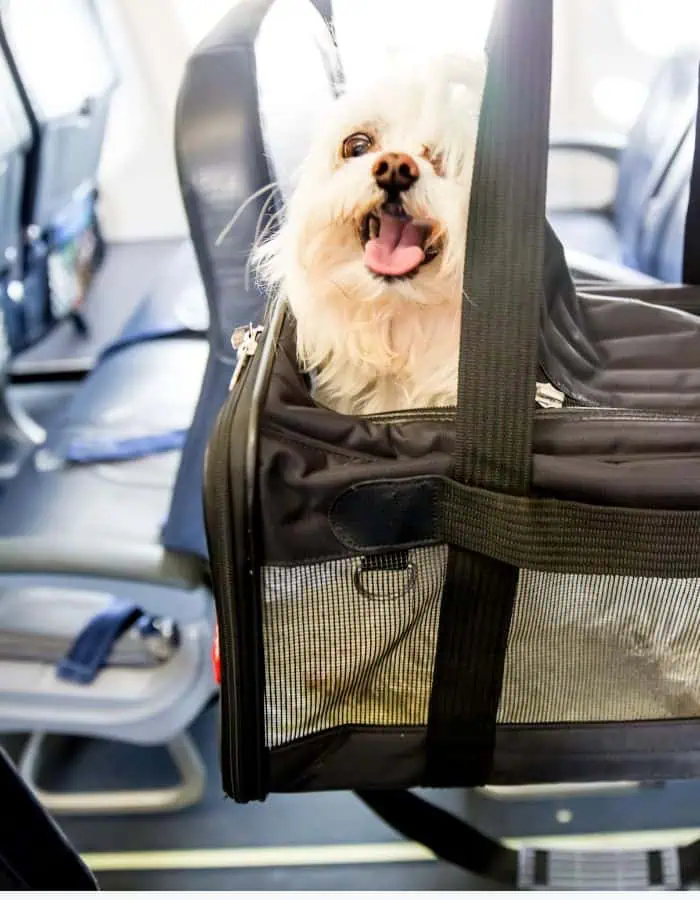
- Your dog must stay in the carrier under the seat for the whole flight.
- Bring a chew to help with pressure changes.
- A calming collar or vest may help if your dog gets anxious.
- For long-haul flights, ask the flight crew if it’s OK to do a quick potty break with a puppy pad in the restroom.
After the Flight
- There might not be a pet relief area until after customs. I’ve used a puppy pad in a bathroom stall more than once.
- Keep your paperwork out. Some countries scan the microchip or compare documents to your dog.
- Be patient. International arrivals can take time.
- Offer water first. Flying is dehydrating.
- Let your dog stretch their legs outside the terminal.
- Head to your accommodation and let your dog settle in with familiar items. A short walk and some downtime helps them adjust.
- Don’t be surprised if they skip their first meal. Appetite usually returns by the next day. If not, offer a little broth or their favorite treat.

Countries That Are Tough for Dog Travel
Not every country rolls out the red carpet for pets. Some places have strict rules, long quarantines, or just make it harder logistically.
If you’re early in your planning or want to avoid headaches, these destinations might be worth skipping (at least for now).
Countries With Complicated Entry:
- Australia and New Zealand: Both require a rabies titer test, import permits, and up to 10 days of quarantine. It’s expensive and takes months to plan.
- United Kingdom: Requires tapeworm treatment, a specific type of microchip, and only allows pet entry through approved routes. You can’t fly directly into the UK with a pet on most airlines.
- Iceland: Doesn’t allow pets to fly in cabin, and quarantine is mandatory.
- Japan: Japan requires dogs to be microchipped and vaccinated against rabies twice, followed by a rabies titer test. An import permit must be obtained at least 40 days before arrival.
- Singapore: Singapore categorizes countries based on rabies risk. Dogs from higher-risk countries must have an import permit, microchip, up-to-date vaccinations, a rabies titer test, and may be subject to quarantine ranging from 10 to 30 days.
- Hawaii While part of the United States, Hawaii has its own stringent pet import regulations to maintain its rabies-free status. Dogs must be microchipped, have two rabies vaccinations, pass a rabies titer test, and meet specific timelines for documentation submission. Non-compliance can result in a quarantine period of up to 120 days.
I’m not saying you can’t go to these places. But if it’s your first time traveling with a dog, start with countries that are a little more flexible.

Returning to the U.S.: Know the New Rules
Bringing your dog back into the U.S. has become more complex, especially if you’ve traveled to a country classified as high-risk for dog rabies.
General Requirements for All Dogs Entering the U.S.
Regardless of where your dog has been, the following are mandatory:
- Age: Dogs must be at least 6 months old at the time of entry.
- Health: Dogs must appear healthy upon arrival.
- Microchip: An ISO-compatible microchip must be implanted before the rabies vaccination. The microchip number must be included on all required documents.
- CDC Dog Import Form: Complete this online form before travel. A receipt will be emailed to you, which must be presented upon arrival. Each dog requires a separate form.
Additional Requirements for Dogs That Have Been in High-Risk Countries
If your dog has been in a high-risk country for dog rabies within the 6 months before entering or returning to the U.S. and was vaccinated in the U.S., the following documents are required:
- Certification of U.S.-Issued Rabies Vaccination Form: This form must be completed by a USDA-accredited veterinarian and endorsed by the USDA. OR
- USDA-Endorsed Export Health Certificate: This certificate must also be completed by a USDA-accredited veterinarian and endorsed by the USDA.
These documents confirm that your dog was vaccinated against rabies in the U.S. and is eligible for re-entry.
For more detailed information, including the list of high-risk countries and specific requirements, please refer to the CDC’s official guidance: Entry Requirements for U.S.-Vaccinated Dogs from High-Risk Countries.
Where to Find the Most Accurate Info
Rules change all the time. Don’t trust random blogs (yes, even this one. Double-check everything).
Here’s where to go for more info:
- USDA Pet Travel – for U.S. departures
- CDC Dog Import Rules – for returning to the U.S.
- My article summarizing the CDC’s rules (updated regularly)
- IATA Travel Centre – international country requirements
- Airline’s official pet travel page
- Embassy/consulate websites
- Expat and dog travel Facebook groups for real-life experiences and updated advice
When You Shouldn’t Fly With Your Dog
The truth is not every dog is cut out for international air travel. And not every trip is worth dragging your pup along.
Times to Think Twice:
- Your dog is elderly or has health issues
- They suffer from severe anxiety or behavioral issues in public
- They’re a large breed (and would need to fly cargo)
- You’re planning a fast-paced or highly urban trip with few green spaces
- You’ll be gone for just a week or two. Sometimes it’s less stressful to leave them with a trusted sitter (Trusted Housesitters is amazing!)
If your dog is better off staying home, there’s no shame in that. Choose what’s best for both of you.
Should You Get Travel Insurance That Covers Pets?
Most people don’t think about this, but some travel insurance policies cover pets, or at least pet-related emergencies.
Look For:
- Trip cancellation coverage in case of a pet emergency before travel
- Emergency vet care abroad
- Lost pet support if something goes wrong
You can also get international pet insurance through providers like:
- Trupanion (has a travel rider)
- Figo (includes travel coverage)
- Petplan (covers emergency vet care abroad)
This is especially worth it if your trip is long, your dog has health concerns, or you’re heading somewhere without easy access to vets.
Common Mistakes to Avoid When Traveling Internationally With a Dog
Even experienced travelers can get tripped up by the extra layers of planning that come with flying internationally with a dog.
Here are some of the most common mistakes I’ve seen and how to avoid them:
- Booking your flight before checking pet availability: Most airlines limit how many pets can fly in-cabin on each flight.
- Assuming all airlines and countries follow the same rules: Some airlines are stricter than others, and every country has its own health certificate and vaccine requirements. Double-check both ends of your trip—and the return.
- Waiting too long to handle paperwork: Health certificates are usually time-sensitive, but that doesn’t mean you can wait until the last minute. You may need multiple vet visits, USDA endorsements, or blood tests that take weeks to process.
- Not checking re-entry rules for the U.S.: This one surprises people. The U.S. has strict return rules, especially if you’re visiting a high-risk rabies country. Make sure you’re cleared to come back in before you leave.
- Overpacking the carrier: It’s tempting to make it cozy with blankets and toys, but many countries only allow the original pad that comes with the carrier.
- Using a collar instead of a harness at the airport: Even the calmest dogs can panic in a busy terminal. A harness gives you better control and is safer for airport security checkpoints.
- Bringing more food than you’re allowed: Some countries limit how much pet food you can bring, especially if it contains beef or pork. Always check before packing that big bag of kibble.
- Skipping carrier training: If your dog only sees the carrier on travel day, they’re going to freak out. Introduce it early.
Wrap-Up: Flying Internationally With a Dog
Flying internationally with your dog isn’t simple, but it is doable. Once you’ve gone through the process once or twice, it gets easier.
You’ll know what to expect, what paperwork you need, and which airlines and countries make the experience smoother.
Yes, there are rules, fees, and forms. But if you’re willing to plan ahead and stay organized, you don’t have to leave your dog behind.
Whether you’re moving abroad, taking an extended trip, or just testing the waters of international travel with your pup, the key is preparation.
Double-check everything. Keep your paperwork in order. And most of all, be honest about what your dog can handle. Not every destination is pet-friendly, and not every dog loves to fly.
But if you’re both up for the adventure, there’s a whole world waiting.
Related Posts
- Requirements for Bringing Dogs Into the United States
- Guide to Planning a Road Trip With A Dog Without The Stress
- Most Dog-Friendly Cities in the World
- Dog-Friendly Cities in Mexico
- Guide to Traveling with a Dog in Mexico
- The Best and Worst Dogs for Digital Nomads
- Can I Be a Digital Nomad With a Dog?
